Delay
A stereo delay with tempo sync or free-running mode, stereo pre-delay, crossfeed for ping-pong effects, LFO modulation, and filtering in the feedback loop.
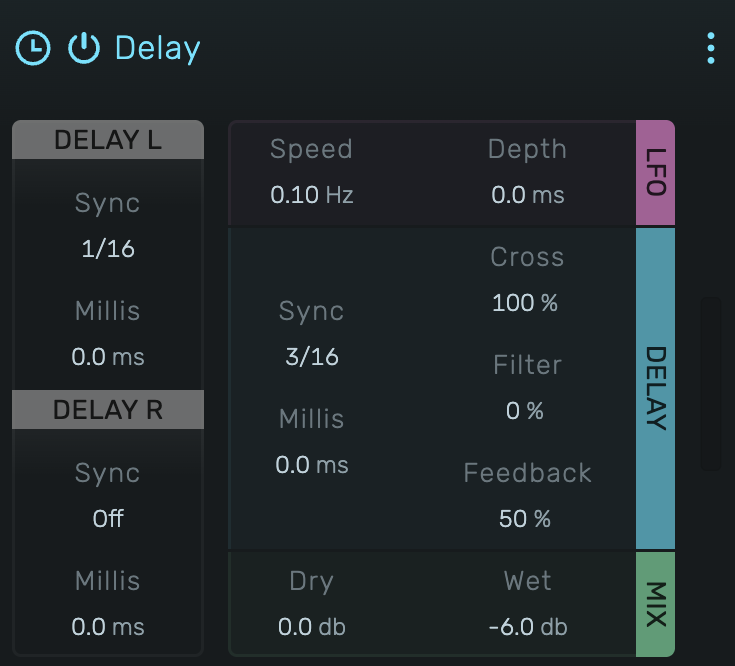
0. Overview
Delay creates echo effects synchronized to the project tempo or set freely in milliseconds. Features stereo pre-delay for offset between channels, crossfeed for ping-pong patterns, LFO modulation for chorus-like movement, and a filter in the feedback path for evolving repeats.
Example uses:
- Rhythmic echoes synced to tempo
- Ping-pong delay effects
- Filtered dub delays
- Chorus-like modulated delays
- Spatial enhancement with stereo pre-delay
1. Pre-Delay Left / Right
Independent pre-delay for each stereo channel, creating offset between left and right delay taps. Each channel has two controls:
Sync (pre sync L / pre sync R): Tempo-synced pre-delay as a musical fraction. Set to "Off" to disable sync and use milliseconds instead.
Milliseconds (pre ms L / pre ms R): Free-running pre-delay time. Range: 0 to 1000 ms. Only active when sync is set to "Off".
Use cases:
- Complex rhythmic patterns with different L/R delay timing
- Asymmetric stereo delay effects
- Widening the wet signal's stereo image
2. Delay Time
Main delay time with two modes:
Sync (delay): Tempo-synced delay time as a musical fraction. Set to "Off" to use milliseconds instead.
Milliseconds (ms): Free-running delay time. Range: 0 to 1000 ms. Only active when sync is set to "Off".
Available musical fractions (ascending):
| Short | Medium | Long |
|---|---|---|
| 1/128 | 1/16 | 1/4 |
| 1/96 | 1/12 | 5/16 |
| 1/64 | 3/32 | 1/3 |
| 1/48 | 1/8 | 3/8 |
| 1/32 | 1/6 | 7/16 |
| 1/24 | 3/16 | 1/2 |
| 3/64 | 1/1 |
Delay time updates smoothly when changed, interpolating over 0.5 seconds to avoid clicks.
3. Feedback
Amount of delayed signal fed back into the delay line. Range: 0% to 100%.
- 0%: Single echo, no repeats
- 50%: Moderate decay, several repeats
- High values: Long decay, many repeats
Note: A built-in limiter prevents runaway feedback and clipping at high feedback values.
4. Cross
Stereo crossfeed amount. Range: 0% to 100%.
- 0%: No crossfeed. Left input echoes on left, right on right.
- 50%: Partial crossfeed. Creates stereo movement.
- 100%: Full crossfeed. Classic ping-pong effect where echoes alternate between left and right.
5. LFO
Low-frequency oscillator modulating the delay time for chorus-like effects and movement.
Speed (lfo speed): LFO rate. Range: 0.1 Hz to 5.0 Hz (exponential scaling).
Depth (lfo depth): Modulation amount in milliseconds. Range: 0 to 50 ms.
- 0 ms: No modulation, static delay time
- Low values (1-5 ms): Subtle chorus/doubling effect
- Higher values: More pronounced pitch wobble and movement
The LFO uses a triangle waveform for smooth modulation.
6. Filter
Filter applied to the feedback signal. Range: -100% to +100%.
- Negative values: Low-pass filter. Repeats get progressively darker (tape/analog character).
- 0%: No filtering. Clean repeats.
- Positive values: High-pass filter. Repeats get progressively thinner/brighter.
The filter uses an exponential frequency mapping from 20 Hz to 20 kHz, applied within the feedback loop so each repeat is filtered again.
7. Dry
Level of the original unprocessed signal. Range: -72 dB to 0 dB.
Set to -72 dB for a 100% wet signal, useful on send/return configurations.
8. Wet
Level of the delayed signal. Range: -72 dB to 0 dB.
Adjust relative to Dry for the desired effect intensity.
9. Technical Notes
- Delay time is recalculated when tempo changes (sync mode)
- Maximum delay time is 1 second (1000 ms) or 1/1 note at current tempo
- Interpolation prevents clicks when changing delay time during playback
- Built-in limiter with 50 ms attack and 250 ms release prevents clipping
- A small gain reduction (0.96x) is applied in the feedback loop for stability