Free Reverb
A lightweight algorithmic reverb based on the classic Freeverb design.
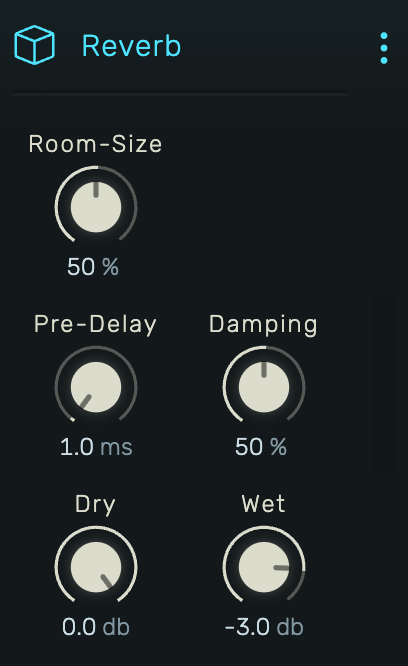
0. Overview
Reverb adds spatial ambience using the Freeverb algorithm—a computationally efficient design using parallel comb filters and allpass diffusers. Good for general-purpose room simulation with low CPU usage.
Example uses:
- Adding room ambience to dry recordings
- Creating depth and space in a mix
- Short ambiences for drums and percussion
- Longer decays for pads and atmospheric effects
1. Room-Size
Controls the decay time of the reverb. Range: 0% to 100%.
Internally maps to feedback coefficients ranging from 0.7 to 0.98:
- Low values (0-30%): Short, tight spaces
- Medium values (30-60%): Natural room sizes
- High values (60-100%): Large halls, long decay tails
2. Pre-Delay
Time before the first reverb reflections. Range: 1 ms to 500 ms (exponential scaling).
Pre-delay separates the dry sound from the reverb tail, helping maintain clarity:
- Short (1-20 ms): Immediate ambience, sounds "attached" to the source
- Medium (20-80 ms): Natural room feel, source stays distinct
- Long (80+ ms): Pronounced separation, audible gap before reverb
3. Damping
High-frequency absorption in the reverb tail. Range: 0% to 100%.
Simulates how real rooms absorb high frequencies over time:
- 0%: Bright, metallic reverb (no damping)
- 50%: Natural room character
- 100%: Dark, muffled reverb (heavy damping)
Higher damping values create warmer, more natural-sounding decay.
4. Dry
Level of the original unprocessed signal. Range: -72 dB to 0 dB.
5. Wet
Level of the reverb signal. Range: -72 dB to 0 dB.
For send/return configurations, set Dry to minimum and adjust Wet to taste.
6. Technical Notes
Algorithm: Freeverb (Jezar at Dreampoint)
- 8 parallel comb filters per channel with lowpass damping in feedback
- 4 cascaded allpass filters for diffusion
- Slightly different delay times for left and right channels create stereo width
- True stereo processing (independent L/R paths)
This is a "cheap" reverb in terms of CPU usage—ideal when you need many instances or are working on limited hardware.